Open data: the untapped layer of customer intelligence
Published 30 March 2026 · 5 min read
How much do you really know about your customers? For many businesses, the answer is surprisingly little — a name, an address, maybe some purchase history. Marketing teams and data analysts often work with just enough information to send an email, but not nearly enough to understand who they're talking to.
That gap between what you know and what you could know is where open data comes in.
What is open data?
Open data is data that is freely available and authorised for distribution and re-use, for both commercial and non-commercial purposes. In the UK, there is a wealth of publicly accessible datasets maintained by government bodies, regulators, and public institutions. These include census and demographic data from the Office for National Statistics, property transaction records from the Land Registry, energy performance certificates from the Department for Levelling Up, Housing and Communities, broadband connectivity data from Ofcom, and weather forecasts from the Met Office, among many others.
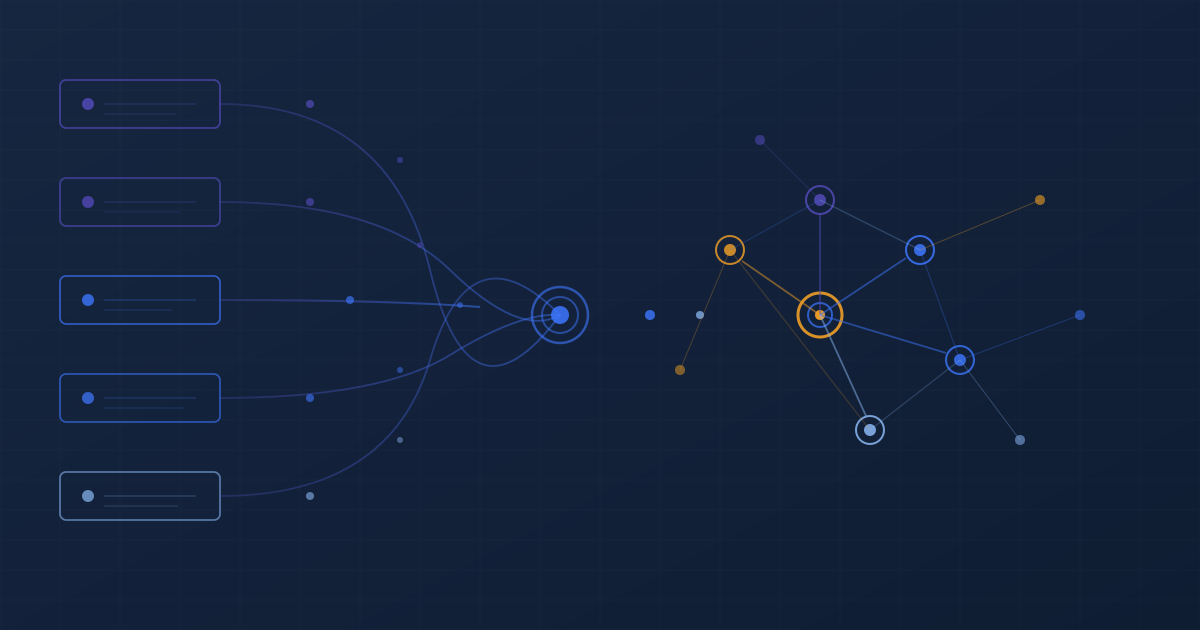
Each of these datasets, on its own, tells a partial story. But when layered together and linked to a customer record — even one as basic as a name and postcode — they can paint a remarkably detailed picture of who that customer is, how they live, and how they're likely to behave.
The problem with traditional data collection
Most businesses build customer profiles through direct interaction: sign-up forms, checkout flows, cookies, surveys. This approach has two significant drawbacks.
First, it places the burden on the customer. Every additional field in a registration form is friction. Every request for personal information risks abandonment. Customers don't want to hand over their life story just to buy a product, and privacy-conscious consumers are increasingly resistant to invasive data collection.
Second, it only captures what happens within the walls of your brand. You see what a customer buys from you, when they visit your site, and which emails they open. But you know nothing about the broader context of their lives — their likely income, the size of their household, the type of neighbourhood they live in, or even whether they have decent internet access.
Open data fills that gap without asking the customer a single additional question.
What open data can reveal
Starting from nothing more than a postcode, open data can help you infer a surprising range of attributes about your customers. Here are some of the key datasets and what they offer.
ONS Census Data provides socio-demographic segmentation at the postcode level. This includes classifications like "Suburban Achievers" or "Constrained City Dwellers" — groupings that describe typical age ranges, employment status, education levels, and lifestyle characteristics. The ONS also publishes detailed pen portraits for each grouping, giving businesses a rich qualitative description of the people who typically live in that area.
Land Registry Data records property transactions, including sale prices, property types, and build age. This acts as a proxy for income: areas with high average property values typically house residents with greater disposable income and spending capacity. It also reveals whether properties are detached, semi-detached, or terraced, which can inform product relevance for home improvement, insurance, and similar sectors.
EPC Data from the Department for Levelling Up provides floor area in square metres and room counts for properties. Combined with Land Registry data, this helps distinguish between expensive city flats and large suburban family homes — a distinction that matters enormously for household-centric products like furniture, carpets, lighting, or home appliances.
Ofcom Connectivity Data shows broadband speeds by area. This has direct implications for marketing strategy: customers in areas with poor connectivity are unlikely to stream video content or engage with bandwidth-heavy digital campaigns. For these customers, email or even physical mail may be a more effective channel.
Met Office Weather Data might seem unusual in a customer profiling context, but it enables weather-triggered marketing. A footwear brand that sees sales spike in rainy conditions can use local weather forecasts to time campaigns. A garden centre can push promotions when sunny weather is forecast in a customer's area. This kind of contextual relevance drives engagement.
See what your postcodes reveal
Send us a sample of your customer postcodes and we'll enrich them with 175+ demographic attributes — from ONS classifications to connectivity scores — at no cost.
Why this matters for your business
The value of open data isn't just that it's free (though it is). It's that it provides an external perspective on your customers that can't be derived from your own transaction and interaction data alone.
Internal data tells you what a customer does with your brand. Open data helps you understand why — and what else they might do. A customer whose postcode suggests high income and a large family home but who has only ever bought your entry-level product isn't a low-value customer. They're an untapped opportunity.
Equally, open data can validate or challenge assumptions. If your segmentation model puts a customer in a "high spender" bracket based on purchase history, but open data suggests they live in a low-income area with constrained connectivity, that's a signal worth investigating.
Getting started
The good news is that these datasets are publicly available and well-documented. The challenge lies in linking them together, keeping them current, and structuring the output in a way that's useful for marketing teams, CRM systems, or — increasingly — AI agents that need structured demographic context to make decisions.
That's exactly the kind of problem Cogstrata was built to solve. We aggregate and continuously refresh open data from across the UK, structure it at the postcode level, and deliver it through an API that integrates with your existing customer data. No painful data collection, no invasive profiling — just a richer understanding of the people you serve.
In our next post, we walk through a practical example: starting with three fictional customers who have nothing but a name and postcode, and showing exactly how each open data layer transforms what we know about them.
Ready to enrich your customer data?
Send us a sample of your customer postcodes and we'll show you exactly what each one reveals. Results in 24 hours, no contract required.
Request a Free Sample