Retail media's off-site problem: the geodemographic layer that fills it
Published 13 August 2026 · 7 min read

Retail media is the fastest-growing corner of advertising, and in 2026 its centre of gravity is moving. For years the pitch was simple: a retailer knows what its logged-in shoppers buy, so it can sell brands precise, closed-loop advertising against that first-party data on its own website and app. That model works beautifully, right up to the point where the shopper leaves the retailer's owned channels. And that is exactly where the money is now flowing. Off-site retail media, where retailers extend their audiences onto social platforms, connected TV, and the open programmatic web, is projected to grow roughly twice as fast as on-site spend through 2026. The problem is that the asset the whole category was built on, first-party purchase data, is thinnest precisely where the growth is. That gap is where durable, area-level context earns its place.
Why retail media's growth is moving off the retailer's own shelf
The UK is Europe's largest retail media market, ahead of France and Germany, and the major grocers have all built substantial media businesses: Tesco through dunnhumby, Sainsbury's through Nectar360, and Boots among them. On-site inventory, though, is finite: there are only so many sponsored-product slots on a search results page. To keep growing, networks have to sell audiences off-site, targeting shoppers across publishers, streaming services, social platforms, and programmatic exchanges. Analysts expect off-site retail media to expand at around double the rate of on-site spend, and the shift is being accelerated by two forces at once:
- Inventory ceilings. On-site placements are capped by traffic and page real estate; off-site opens the entire open web and CTV as sellable audience reach.
- Signal loss. As third-party cookies and cross-site identifiers become less reliable, brands are paying a premium for audiences grounded in real, deterministic retailer data rather than fading behavioural proxies.
The strategic promise is compelling: take the retailer's understanding of its shoppers and activate it wherever those shoppers spend their attention. But that promise quietly assumes the retailer actually holds rich, matchable data on every person it wants to reach off-site. In practice, it often doesn't.
First-party data runs out at the edges
First-party retail data is deep but narrow. It is excellent for loyalty-card members who scan every shop, and it collapses at the edges of the customer base, where off-site most of the addressable audience actually sits. Consider where the gaps open up: guest checkouts and logged-out browsing that never attach to a known profile; new-customer prospecting, where by definition the retailer has no purchase history at all; long-tail and infrequent shoppers whose handful of transactions say little about who they are; and the match-rate erosion that happens whenever a retailer tries to find its known customers inside a social platform or an exchange. Every one of these is a case where the network is selling reach against people it barely knows. The result is that off-site campaigns quietly fall back on the same broad, third-party behavioural segments that retail media was supposed to replace, which undermines the entire premium proposition. What is missing is a consistent, always-available layer of context that describes a shopper even when the transaction log is silent.
How much of your audience is off-site and anonymous?
Enrich a sample of customer postcodes and see how geodemographic context extends addressability beyond your loyalty base, across all 24 groups.
Geodemographics as the portable context layer
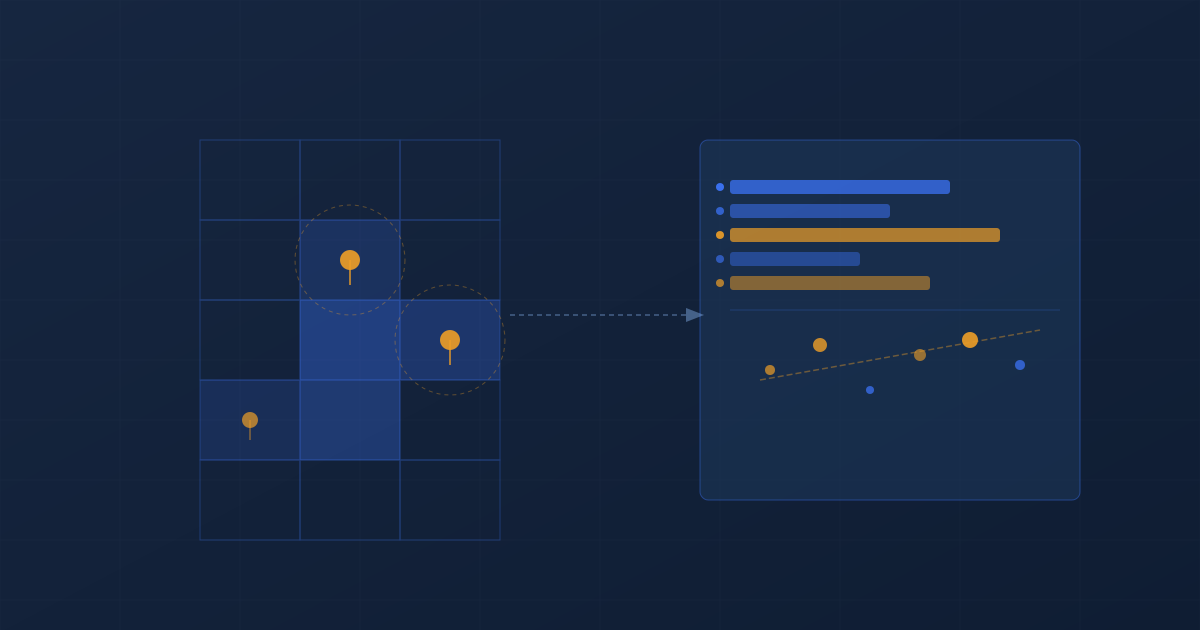
Area-level geodemographics fill the gap that first-party data leaves because they attach to something the retailer almost always has, even for an anonymous or brand-new shopper: a postcode, captured at delivery, checkout, or sign-up. A postcode is not personal data about an individual, but it maps to the demographic character of a neighbourhood, and that neighbourhood context travels wherever the audience goes. Cogstrata resolves any UK postcode into a 24-group, 8-supergroup classification backed by 5,000+ derived attributes covering housing tenure, financial resilience, life stage, digital engagement, retail access, and far more. For a retail media network, that turns a thin identifier into a rich, activatable profile in three ways:
- It extends reach beyond the loyalty base. Guests, prospects, and logged-out visitors can be profiled by neighbourhood the moment a postcode is known, rather than being written off as unaddressable.
- It is channel-agnostic. A geodemographic group is a durable structural trait, not a cookie or a device ID, so the same audience definition can be applied on-site, in a clean room, and across off-site programmatic and social buys.
- It is GDPR-safe by construction. Because the data describes an area rather than a named person, it can be shared with brand partners and activated off-site without carrying individual personal data into every media buy.
None of this replaces first-party purchase data where it exists. It complements it, thickening the audience precisely where the transaction log thins out.
A common audience language for retailers and brands
Off-site retail media only works when a retailer and a brand can agree on who they are targeting, and today that agreement is hard because each side speaks a different data dialect. The retailer describes audiences in loyalty segments; the brand thinks in its own CRM and category terms; the platform offers its own opaque interest clusters. A shared, standardised geodemographic taxonomy gives both parties a neutral common language. A brand launching a premium range can specify the neighbourhood profile it wants (mortgage-active, higher discretionary spend, family life stage), and the retailer can build that audience from postcodes and match it into a clean room or an off-site buy without either side exposing individual customer records. Because the same 24 groups apply across every retailer, brands can plan and compare audiences consistently rather than relearning a bespoke segmentation for each network. That interoperability is exactly what a fragmenting, multi-network retail media landscape is short of, and it is the same portability logic now being pushed at the policy level through the UK's smart data agenda, a theme we explored in The UK's Smart Data Strategy and the future of customer data enrichment.
Why freshness decides whether the audience is real
An audience layer for retail media is only as good as its currency, because shopping behaviour is tied to circumstances that move. Household budgets tighten, neighbourhoods gentrify or decline, high streets lose anchor stores, new housing changes the tenure mix of a postcode. The legacy geodemographic products that many marketers still lean on, CACI Acorn and Experian Mosaic, refresh on slow annual or multi-year cycles, which means an off-site campaign can be optimised against a picture of a neighbourhood that is two or three years out of date. In a channel where budgets are reallocated weekly and incrementality is scrutinised campaign by campaign, that lag is a real cost. Cogstrata's attributes refresh continuously against live signals such as employment, housing, retail access, and connectivity, so the audience a network activates off-site reflects the neighbourhood as it is now, not as it was at the last census-driven update. For more on why refresh cadence matters, see The True Cost of Stale Data.
The bottom line for retail media networks
Retail media's next phase is being won or lost off-site, where the first-party data that built the category is at its weakest. An always-on, area-level context layer closes that gap: it extends addressable reach to guests and prospects, gives retailers and brands a shared audience language that travels across channels and clean rooms, stays on the right side of GDPR because it describes places not people, and, when it refreshes continuously, keeps the audience honest as neighbourhoods change. For networks trying to make off-site reach as credible as their on-site closed loop, that is the missing layer.
Extend your retail media audiences beyond first-party data
Send us a sample of customer postcodes and we'll return them enriched with geodemographic group, housing profile, financial resilience signals, retail access scores, and 5,000+ more attributes. No contract required.
Request a Free Sample